The most successful applications in the year 2026 aren't defined by their features or convenience only, but by how intelligently the apps respond to the users. Reshaping the app industry with highly user-centric, intelligent applications, AI in mobile app development has become integral to every stage of the development cycle. AI, which was once an experimental tool, has now become an essential one, enabling faster, smarter, and more personalised product scaling. Integrating AI into mobile app development transcends executing preset commands by delving into the layers of what people need, tailoring their experience, and making automated decisions.
However, amidst all the buzzwords and bold claims, the question still lingers for developers, businesses and users alike: "Is the hype of AI in mobile apps real?" Well, that's what this blog answers. Let's decode the ways AI is transforming mobile app development today and where it's taking mobile apps next.
What is AI in Mobile App Development?
AI in mobile app Development is the process of integrating artificial intelligence capabilities to build mobile apps. It includes conceptualising, designing, programming, and developing AI and ML-powered features. Mobile app development with AI also refers to data-driven systems that create more personalised, efficient, and smarter apps that can make decisions using real-time data and adapt to different requirements.
AI, or Artificial Intelligence: It refers to a computer system designed to perform tasks that require human intelligence, such as problem-solving, pattern recognition, and decision-making, by processing massive amounts of data to simulate human-like reasoning.
ML (machine learning): It is a type of artificial intelligence where systems learn from data to find patterns and make predictions or decisions. Machine learning is a subset of AI. It allows apps to learn from past data instead of being explicitly programmed for every scenario.
Data-Driven Systems: A data-driven system is an architecture in which the analysis and interpretation of collected data guide operations, processes, and decisions. The more data they process, the more accurate and smarter the apps become.
The traditional mobile apps operated according to fixed rules. Developers wrote instructions, and the apps followed the same-no innovation, no adaptation and no learning. Everything in a program was done through a directed process, in which apps responded only to what they were explicitly programmed to do, produced the same outcome for every user, and relied on manual code modifications.
Cut to the present: AI-based app development replaces a rigid model in which mobile apps don't just follow instructions but also learn, adapt, and evolve with every user interaction. AI-powered apps use algorithms to learn from data and adapt behaviour. These apps adjust content and features based on individual behaviour and can autonomously introduce new insights and improve existing features through ongoing learning. There's a fine line between the apps that function and apps that understand their users, and that's what AI-powered apps do!
Common AI Technologies Used in Mobile Apps
The modern mobile application relies on several AI technologies to enhance security, functionality and user experience through these core AI technologies:
- Natural Language Processing (NLP): Powers virtual assistants, semantic search and chatbots.
- Computer Vision: Enables videos to "see" and interpret images and videos for features such as object detection, facial recognition, and AR filters.
- Predictive Analysis: uses historical data, statistical models, and machine learning to forecast future outcomes, trends, and behaviour.
- Speech Recognition: The ability of an app to convert spoken language into written text that enables devices to understand and process human voice commands.
Key Ways AI Is Transforming Mobile App Development
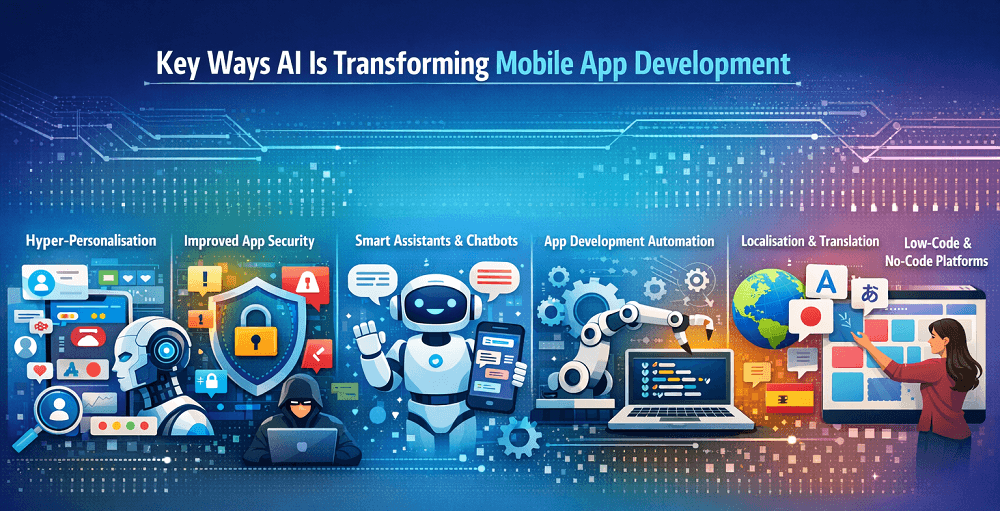
Hyper-personalisation
One of the most powerful uses of AI is personalisation. Machine learning models analyse and understand the behaviour, like what they search, what they click, and their interaction with the app, and preferences of the users to deliver tailored content in the app. This leads to more meaningful experiences and higher engagement.
Improved App Security
App security is a significant concern, and AI helps protect data. AI models can detect suspicious, security-related, or abnormal behaviour in real time. It detects unusual activity and prevents cyberattacks, ensuring that your apps aren't just smart but also secure and safe.
Smart Assistants and Chatbots
The AI-powered chatbots and voice assistants have taken a front seat, being more conversational and context-aware to help users interact with apps more naturally. These smart assistants and chatbots not only solve problems but also complete purchases without human support, making the process seamless.
App Development Automation
AI tools assist developers in automating coding, testing, and debugging and edge the vase by simulating real user behaviour. They reduce QA time by predicting cases likely to occur, thereby decreasing app development costs and time.
Localisation and Language Translation
Localisation and Language Translation AIs are robust tools that automatically translate app content into multiple languages. It even adapts content culturally for different regions, significantly reducing the manual effort traditionally required for global release.
Low-Code and No-Code Platforms
AI-powered development platforms allow non-programmers to create functional apps using drag-and-drop tools. It speeds up app development and makes it more accessible for small businesses and startups by generating code in the background.
Moreover, to better understand the impact of AI, let's explore industry use cases of AI in mobile apps.
Industry Use Cases of AI in Mobile Apps
Healthcare
AI-driven healthcare apps enhance operational efficiency and patient care. It enables personalised treatment plans by analysing patient data. Apps help patients to understand potential health issues via AI-powered chatbots and symptom analysis tools. Wearable-connected apps analyse heart rate, sleep, and activity data to detect abnormalities and send alerts.
Fintech
AI keeps track of credit scores and smart budgeting, detects fraud, and enhances security in financial apps. AI-powered robo-advisors provide budget recommendations and customised investment advice tailored to an individual's financial goals.
E-Commerce & Retail
AI in e-commerce apps recommends visual search, products, and dynamic pricing. It allows customers to interact with chatbots to track orders and support, upload images, and receive personalised offers. Moreover, the AI algorithms predict future demand and also help retailers optimise stock levels.
Fitness
AI makes fitness more interactive, practical, and tailored to individual needs. It creates personalised fitness plans based on user details and fitness goals. AI adjusts training routines based on user activity, performance, and goals. The fitness apps and intelligent virtual coaches answer users' questions and keep them motivated and engaged in their fitness journeys.
Logistics & On-Demand Services
AI analyses weather, traffic, and delivery schedules to optimise routes. The machine learning models provide real-time and accurate estimates of times of arrival. AI efficiently matches drivers with customers, anticipates surges in demand for on-demand services, reduces fuel consumption, and ensures adequate resource location.
Challenges in AI-Powered Mobile App Development
AI's role in mobile app development is crucial and beneficial, yet it comes with several challenges that we will discuss further.
- Technical complexity: Integrating AI with existing systems, managing massive datasets, or optimising models for resource-constrained mobile devices is difficult.
- Data privacy and security: Collecting and protecting user data is challenging, as it is prone to breaches and misuse, making it difficult to maintain functionality while safeguarding sensitive data.
- High development costs: AI-powered apps require skilled developers and resources, including advanced infrastructure and data scientists. This increases maintenance and development costs.
- Now that we have explored everything about AI in mobile app development in the current era, let's use what it has in store for us in the future.
Future Trends: What's Next for AI in Mobile Apps
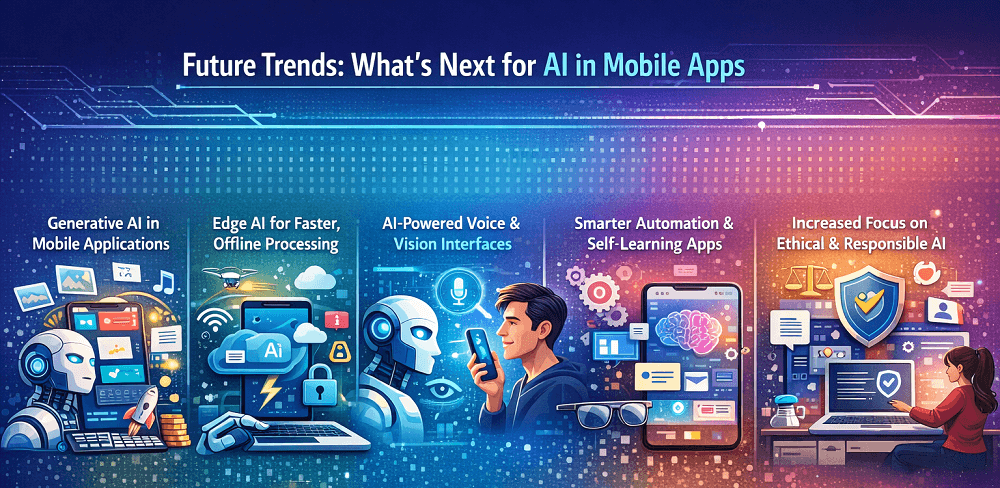
Generative AI in Mobile Applications
Generative AI, driven by DALL·E and GPT models, is revolutionising content creation for apps. It enables apps to automatically create content such as music, code, images, text, and personalised responses, making users expect and experience more human, content-aware interactive storytelling and visual assistance. When marketing materials are created with AI, avatars are customised, and blog posts are authored with a writing app, it accelerates content creation and drastically reduces production costs.
Edge AI for Faster, Offline Processing
Edge AI is the deployment of artificial intelligence algorithms directly on local devices to process data close to its source, rather than relying solely on the cloud. This enhances the speed, reliability, and privacy of AI processing, enabling powerful AI features such as natural language processing and face recognition to run faster even without an internet connection.
AI-powered Voice and Vision Interfaces
Future mobile apps will rely more on voice commands and visual inputs. The way users interact with apps has become more intuitive. Rather than traditional touch-based interaction, users can search, navigate control settings, and compose messages by speaking, making apps much more convenient and faster. Moreover, vision-based AI will enable apps to identify and blend digital information with the real world, providing instant visual and search capabilities. AI-powered vision and voice interfaces will make mobile apps more human-like, inclusive, and efficient.
Smarter Automation and Self-learning Apps
Over time, mobile applications will become more intelligent by learning from user behaviour. Future apps will move to proactively automating tasks rather than simply following commands. Apps will anticipate needs, optimise workflows, personalise interfaces, and manage complex schedules automatically via self-learning algorithms. Therefore, more innovative automation will enable proactive decision-making, with apps taking action on behalf of users.
Increased Focus on Ethical and Responsible AI
One big issue is algorithmic bias, which happens when AI models are trained on unbalanced or biased data. However, as AI becomes more powerful, future mobile apps will place greater emphasis on fairness, transparency, data privacy, and reduced bias. Developers will be able to create AI that users can easily trust and explain. Companies and developers will have to build AI systems that are secure, compliant with regulations, and that ensure user trust and responsible innovation.
Why Choose the Right Mobile App Development Company?
Integrating AI into mobile apps brings exciting possibilities, but it also requires careful planning and expertise, so it is essential to choose the right mobile app development company in Ahmedabad. Here are the reasons why selecting the right mobile app development company is critical.
Technical expertise: A leading mobile app development company consists of a team of experienced experts. They possess in-depth knowledge of the latest industry trends, emerging technologies, and best practices.
Tailored solutions: Choosing a professional mobile app development service in India takes time to understand a business's needs, target audience, and goals, and then creates custom apps.
Quality assurance: A reputable app development company follows a structured testing process to remove bugs, maintain device compatibility, and ensure seamless performance.
Ongoing support and maintenance: Launching an app isn't the final destination; it's just the beginning. Therefore, the right app development company provides continuous post-launch maintenance and updates, as well as scalability for future growth, ensuring that the app remains secure, optimised, and functional.
Security & Data Protection: With rising concerns about data privacy and cyber threats, ensure you choose a trusted development partner that implements strong security practices, such as encryption, secure authentication, and compliance with industry standards and regulations.
Conclusion
In 2026, artificial intelligence will be a core driver of innovation in mobile app development. Integrating AI into mobile app development brings immeasurable efficiency, innovation, and personalisation to modern mobile apps. Companies that embrace this shift aren't just adapting; they're leading the next wave of digital evolution. So when AI mobile app development is redefining the future of digital engagement, what are you waiting for? Partner with the right mobile app development company that transforms your vision into a future-ready application and delivers a more engaging digital experience to the users.