As the digital landscape continues to expand at an unprecedented pace, modern web platforms are evolving faster than ever. Today’s organisations expect lightning-fast performance, seamless scalability, and deeply personalised user experiences to meet rising customer demands. The growing focus on speed and digital user experience is evident in industry data, highlighting how critical these capabilities have become for online success.
Studies indicate that nearly 64% of organisations now prioritise scalability and personalisation as key reasons for replatforming their CMS infrastructure, signalling a clear shift toward next-generation digital solutions. While traditional CMS platforms such as WordPress, Drupal, and Joomla once dominated the web and powered a significant portion of online experiences, they are increasingly challenged by modern requirements. Their tightly coupled architectures often restrict omnichannel delivery, slow down deployment cycles, and limit the ability to deliver advanced, user-centric features, challenges that even a seasoned WordPress development company in Ahmedabad must address when building scalable, future-ready solutions.
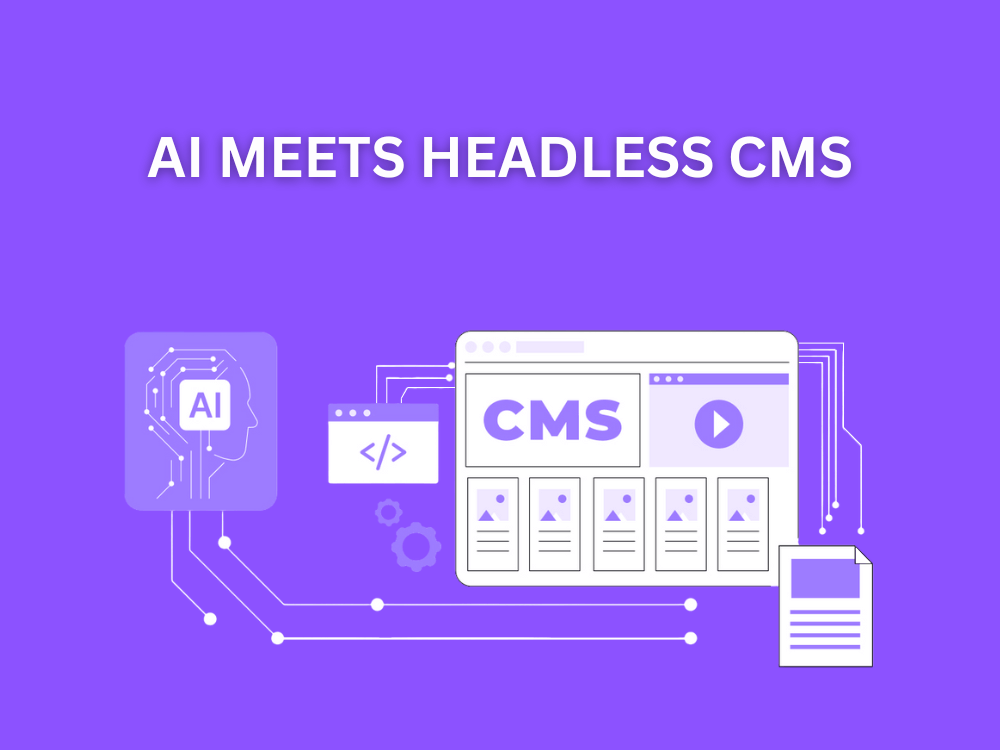
The rise of Headless CMS and Artificial Intelligence (AI) is transforming how content is created, managed, and distributed. By separating content storage from presentation, headless architectures enable developers to deliver content seamlessly across websites, mobile apps, voice interfaces, and IoT devices. At the same time, AI enhances web platforms through intelligent automation, personalised content recommendations, and smarter developer workflows powered by machine learning. Together, these technologies are redefining AI for web development and shaping the future beyond the limitations of traditional CMS platforms.
What is a Headless CMS with AI?
Headless Content Management Systems (CMS) separate the "how" of delivering your content from the "what." Then you can deliver your content to any number of channels (websites, kiosks, smart watches, etc.), but that's not where it stops.
AI turns a headless CMS into a Smart CMS by supporting tagging, organisation, optimisation, and personalisation of your content. An AI-enabled CMS also provides capabilities around generating content, automating approvals and recommending what will work best for your audience.
Think of this as a foundation of intelligence on top of a stable platform that allows marketing teams to act faster, make better choices and develop their marketing strategy based on facts and logic
How AI Powers a CMS and Why it Changes Everything?
Although most CMS platforms weren't conceived to manage content at the rate we're producing it now, the result is fragmented content as well as slower workflows and minimal personalisation. AI is not only fixing these gaps in CMS today but is also changing how we do business with our clients, ultimately resulting in expanding the boundaries of content production through new technologies.
Let’s break down what actually happens under the hood and what that means for your team:
- Automated Publishing and Approvals: AI-driven workflows intelligently route content based on user behaviour, roles, and historical patterns, reducing manual handoffs and speeding up approvals.
- Personalised User Experiences: AI personalisation engines analyse real-time behaviour to deliver relevant, tailored content to every visitor.
- Intelligent Tagging and Metadata with NLP: Using Natural Language Processing, the CMS understands content context and meaning, not just keywords, enabling automatic tagging that improves searchability, structure, and reuse.
- Scalable Multilingual and Localisation Support: Machine learning identifies content inconsistencies, recommends localised adjustments, and minimises duplication across regions and languages.
- AI-Assisted Content Creation and Optimisation: Generative AI supports teams with outlines, summaries, and headline suggestions while maintaining brand tone and structure.
- Predictive Content Performance Insights: Predictive analytics identify underperforming content early, allowing teams to optimise before relevance declines.
- Enhanced Content Discovery: Semantic search and NLP help teams quickly locate content by topic, audience, or use case, improving productivity and efficiency.
All together, these tools eliminate repetitive effort and reduce decision overload. They empower proactive strategy, rapid iteration, and consistently higher-quality results. The future of CMS goes beyond headless-it’s smart, adaptive, and designed to scale.
How AI-Powered CMS Platforms are Redefining Enterprise Content Management?
Modern enterprises across publishing, eCommerce, media, and SaaS face a common pressure: produce more high-quality content at speed, maintain consistency, and drive engagement, without endlessly scaling teams. AI-powered CMS platforms solve this by embedding machine learning into content workflows, enabling organisations to work smarter instead of harder.
When merged with a headless architecture, AI transforms the CMS into an intelligent system that accelerates delivery, reduces errors, ensures brand consistency, and adapts effortlessly to evolve technologies. This makes AI-driven CMS platforms not just a competitive advantage, but a foundational requirement for scalable, future-ready digital operations.
Key outcomes enterprises achieve with AI-powered CMS:
- Strong centralised governance with flexible local execution.
- Consistent brand voice across regions, languages, and channels.
- A future-proof CMS that evolves with technology shifts.
- Faster time-to-market without team burnout.
- Personalised content experiences that boost engagement.
Building Scalable Web Platforms with AI+Headless CMS
Scalability today extends far beyond managing traffic spikes, it means enabling rapid business growth, supporting multiple digital channels, and keeping pace with ever-changing user expectations. The fusion of AI and headless CMS creates a strong foundation for building web platforms that scale smoothly without adding operational complexity. By separating content from its presentation layer and embedding intelligence into the system, organisations gain the agility to adapt quickly, innovate continuously, and grow with confidence.
An AI-powered headless CMS is built on an API-first, cloud-native architecture, allowing seamless integration with modern front-end frameworks, microservices, and third-party applications. This setup enables development teams to roll out updates independently across websites, mobile apps, kiosks, and new platforms, without impacting the core content infrastructure. As content volumes and traffic increase, cloud services and APIs help maintain stable, high-performance delivery.
AI further enhances scalability by automating tasks that were traditionally manual. Intelligent systems can manage content tagging, categorisation, localisation, and quality checks, significantly reducing production bottlenecks as operations expand. At the same time, machine learning analyses user behaviour and performance metrics to optimise content delivery and personalise experiences in real time, eliminating the need for rigid, rule-based configurations.
From a development standpoint, combining AI with a headless CMS speeds up iteration cycles. Teams can experiment, deploy, and improve features faster, guided by data-driven insights that inform what content to create, refine, or phase out. The result is quicker time-to-market, lower technical debt, and a web platform that evolves continuously, supporting flexibility, performance, and intelligence at scale while remaining ready for future growth and technologies.
Key Benefits for Enterprise and Growing Businesses
AI-powered headless CMS platforms empower enterprises and scaling businesses with the agility, adaptability, and performance required in today’s fast-paced digital ecosystem. By separating content management from the presentation layer, organisations can create, deploy, and update experiences rapidly across web, mobile, and emerging channels without being constrained by traditional architectures.
With cloud-native, API-first foundations, these platforms deliver stable performance as traffic, content volume, and digital touchpoints expand, enabling effortless global scalability without added complexity.
At the same time, AI enhances content operations through intelligent automation, real-time personalisation, and predictive analytics. This allows businesses to deliver highly relevant experiences at scale while minimising manual effort. Combined with centralised control and local flexibility, AI-driven headless CMS platforms ensure brand consistency, future readiness, and a strong foundation for long-term digital growth.
Common Challenges with Implementing an AI CMS
Trust in Automation
Not everyone is immediately comfortable letting a machine suggest what to write or when to publish. Building confidence takes time and good results.
Quality Assurance and Oversight
AI can generate and optimise, but it still needs a human layer to ensure brand voice, accuracy, and relevance remain on point.
Change Management and Team Adoption
AI-powered tools may need teams to work differently, from how content is structured to how decisions are made. Training and alignment are key.
Technology Bloat and Overchoice of Features
Some platforms try to do too much. A crowded CMS with rarely used AI features can confuse teams instead of helping them.
Governance and Compliance
Automated content flows still need rules. Enterprise teams must ensure AI doesn’t introduce risk by bypassing checks.
The Future of AI-Driven Headless Web Platforms
The future of AI-driven headless web platforms is focused on intelligence, flexibility, and scale. By combining AI with composable, headless architectures, web platforms will deliver real-time personalisation, automated content decisions, and seamless performance across all digital channels.
As technology evolves, these platforms will adapt faster to user behaviour, new devices, and changing business needs, making AI-powered headless systems the foundation for scalable, future-ready digital experiences.
Final Thoughts
In conclusion, the convergence of AI and headless CMS represents a decisive shift in how scalable, future-ready web platforms are built. As traditional CMS architectures struggle to meet modern demands for speed, personalisation, and omnichannel delivery, AI-powered headless systems offer a flexible and intelligent alternative. By decoupling content from presentation and embedding AI-driven automation, insights, and personalisation into content operations, organisations can innovate faster, scale efficiently, and deliver consistently relevant experiences across every digital touchpoint.
Moving forward, AI-driven headless CMS platforms will move from being a competitive advantage to a foundational necessity, enabling enterprises and MSMEs to adapt seamlessly to evolving technologies, user behaviours, and global expansion in an increasingly digital-first world.